
Power Electronics Researcher and Engineer with PhD specializing in advanced modeling, control, and performance evaluation of power electronic systems. Experienced in high-frequency converter design, loss analysis, and system-level simulation using MATLAB/Simulink and PSIM. Strong background in harmonic mitigation, grid integration, and EV charging systems, with growing focus on Wide Band Gap (WBG) semiconductor devices, including SiC-based converter architectures, thermal considerations, and high-frequency operation.

Raheni T D
Senior Engineer - Simulation Engineer | Blue Binaries Engineering and Solutions Private Limited
Geylang, Singapore
Summary
Education
'%3e%3crect%20width='48'%20height='48'%20rx='4'%20fill='%23E6E3F9'/%3e%3crect%20width='0.6'%20height='10'%20transform='matrix(-1%200%200%201%2042.3999%2024)'%20fill='%2367E2F2'/%3e%3cpath%20d='M44%2036C44%2037.1046%2043.1046%2038%2042%2038C40.8954%2038%2040%2037.1046%2040%2036C40%2034.8954%2040.8954%2034%2042%2034C43.1046%2034%2044%2034.8954%2044%2036Z'%20fill='url(%23paint0_linear_2586_8632)'/%3e%3cpath%20d='M42%2036L43.7321%2042H40.2679L42%2036Z'%20fill='url(%23paint1_linear_2586_8632)'/%3e%3crect%20x='-12'%20y='21.5'%20width='48'%20height='32'%20rx='2'%20fill='%236754C8'/%3e%3cpath%20d='M15.5493%2010.4661C16.1408%2010.1135%2016.8721%2010.0901%2017.485%2010.4041L41.5254%2022.72C42.9762%2023.4632%2042.9762%2025.5368%2041.5254%2026.28L17.485%2038.5959C16.8721%2038.9099%2016.1408%2038.8865%2015.5493%2038.5339L-5.11706%2026.2181C-6.41859%2025.4424%20-6.41859%2023.5576%20-5.11706%2022.7819L15.5493%2010.4661Z'%20fill='url(%23paint2_linear_2586_8632)'/%3e%3ccircle%20cx='31.9247'%20cy='24.1795'%20r='1.5'%20transform='rotate(-3.37875%2031.9247%2024.1795)'%20fill='white'/%3e%3ccircle%20cx='23.5357'%20cy='27.282'%20r='1.5'%20transform='rotate(-3.37875%2023.5357%2027.282)'%20fill='white'/%3e%3c/g%3e%3cdefs%3e%3clinearGradient%20id='paint0_linear_2586_8632'%20x1='38.0748'%20y1='42'%20x2='47.3606'%20y2='39.6343'%20gradientUnits='userSpaceOnUse'%3e%3cstop%20offset='0.0781'%20stop-color='%239685F4'/%3e%3cstop%20offset='1'%20stop-color='%2367E2F2'/%3e%3c/linearGradient%3e%3clinearGradient%20id='paint1_linear_2586_8632'%20x1='38.0748'%20y1='42'%20x2='47.3606'%20y2='39.6343'%20gradientUnits='userSpaceOnUse'%3e%3cstop%20offset='0.0781'%20stop-color='%239685F4'/%3e%3cstop%20offset='1'%20stop-color='%2367E2F2'/%3e%3c/linearGradient%3e%3clinearGradient%20id='paint2_linear_2586_8632'%20x1='-20.7546'%20y1='11.7454'%20x2='57.7546'%20y2='37.2546'%20gradientUnits='userSpaceOnUse'%3e%3cstop%20offset='0.0781'%20stop-color='%239685F4'/%3e%3cstop%20offset='1'%20stop-color='%2367E2F2'/%3e%3c/linearGradient%3e%3cclipPath%20id='clip0_2586_8632'%3e%3crect%20width='48'%20height='48'%20rx='4'%20fill='white'/%3e%3c/clipPath%3e%3c/defs%3e%3c/svg%3e) Kumaraguru College of Technology Ph.D., Electrical and Electronics Engineering Grade : CGPA: 9.5/10 Jan 2017 - Dec 2023
Kumaraguru College of Technology Ph.D., Electrical and Electronics Engineering Grade : CGPA: 9.5/10 Jan 2017 - Dec 2023- Kumaraguru College of Technology Ph.D., Electrical and Electronics Engineering Grade : CGPA: 9.5/10 Jan 2017 - Dec 2023
Experience
'%3e%3crect%20x='0.5'%20width='64'%20height='64'%20rx='8'%20fill='%23E6E3F9'/%3e%3cpath%20fill-rule='evenodd'%20clip-rule='evenodd'%20d='M44.4684%2011.2093C45.323%2011.7834%2045.8334%2012.7311%2045.8334%2013.7437V71.5903C45.8334%2073.2895%2044.4222%2074.667%2042.6813%2074.667H14.3188C12.578%2074.667%2011.1667%2073.2895%2011.1667%2071.5903V25.3228C11.1667%2024.0475%2011.9728%2022.9044%2013.1932%2022.449L41.5557%2010.8699C42.5247%2010.5083%2043.6139%2010.6352%2044.4684%2011.2093Z'%20fill='%236754C8'/%3e%3cpath%20fill-rule='evenodd'%20clip-rule='evenodd'%20d='M28.0802%2029.6378C28.6491%2029.2817%2029.364%2029.2345%2029.9764%2029.5127L55.3543%2041.0415C56.0531%2041.359%2056.5003%2042.0452%2056.5003%2042.8002V72.7279C56.5003%2073.7985%2055.6149%2074.6663%2054.5226%2074.6663H29.1447C28.0525%2074.6663%2027.167%2073.7985%2027.167%2072.7279V31.2715C27.167%2030.6099%2027.5113%2029.9939%2028.0802%2029.6378Z'%20fill='url(%23paint0_linear_2515_20613)'/%3e%3ccircle%20cx='45.9958'%20cy='45.5768'%20r='2.06863'%20transform='rotate(-3.92943%2045.9958%2045.5768)'%20fill='white'/%3e%3cellipse%20cx='34.7058'%20cy='42.2052'%20rx='2.06864'%20ry='2.06864'%20transform='rotate(-3.92943%2034.7058%2042.2052)'%20fill='white'/%3e%3c/g%3e%3cdefs%3e%3clinearGradient%20id='paint0_linear_2515_20613'%20x1='26.325'%20y1='65.8186'%20x2='57.9007'%20y2='59.5553'%20gradientUnits='userSpaceOnUse'%3e%3cstop%20offset='0.160358'%20stop-color='%239685F4'/%3e%3cstop%20offset='1'%20stop-color='%2367E2F2'/%3e%3c/linearGradient%3e%3cclipPath%20id='clip0_2515_20613'%3e%3crect%20x='0.5'%20width='64'%20height='64'%20rx='8'%20fill='white'/%3e%3c/clipPath%3e%3c/defs%3e%3c/svg%3e) Senior Engineer - Simulation Engineer Blue Binaries Engineering and Solutions Private Limited May 2026 - Jun 2026 • 2 mos
Senior Engineer - Simulation Engineer Blue Binaries Engineering and Solutions Private Limited May 2026 - Jun 2026 • 2 mos
Wireless Power Transfer Based Battery Charging System • Developed a Proof of Concept for wireless EV battery charging using inductive power transfer. • Modelled lithium-ion battery charging characteristics and analyzed efficiency under varying load conditions. • Simulated charging control algorithms and thermal behavior using MATLAB/Simulink. • Evaluated system performance including charging efficiency, power transfer capability, and battery safety parameters.
- Senior Engineer - Simulation Engineer Blue Binaries Engineering and Solutions Private Limited May 2026 - Jun 2026 • 2 mos
Wireless Power Transfer Based Battery Charging System • Developed a Proof of Concept for wireless EV battery charging using inductive power transfer. • Modelled lithium-ion battery charging characteristics and analyzed efficiency under varying load conditions. • Simulated charging control algorithms and thermal behavior using MATLAB/Simulink. • Evaluated system performance including charging efficiency, power transfer capability, and battery safety parameters.
Work Preferences
Role preference
Actively applying
Expected job titles
Electrical Engineer
Electric vehicle
MATLAB Simulink
Power Electronics
Power Converters
Skills
High-frequency power converter modeling (LLC, CLLC, PFC topologies)
High-frequency power converter modeling (LLC, CLLC, PFC topologies)
Loss analysis and efficiency optimization of power converters
Loss analysis and efficiency optimization of power converters
Thermal considerations in high-power density systems
Thermal considerations in high-power density systems
EMI and harmonic mitigation in grid-connected converters
EMI and harmonic mitigation in grid-connected converters
MATLAB/Simulink-based device and system-level modeling
MATLAB/Simulink-based device and system-level modeling
Exposure to high-voltage (400V/800V) architectures relevant to SiC applications
Exposure to high-voltage (400V/800V) architectures relevant to SiC applications
Control of fast-switching converters and parasitic-aware system behavior
Control of fast-switching converters and parasitic-aware system behavior
System integration, validation, and documentation
System integration, validation, and documentation
MATLAB Simulink (R2018b, R2022b), MATLAB Simscape Power Systems, PSIM, PSPICE, REACTIS 2022.2, Requirement Validation, System Verification, Test documentation, Technical Reporting
MATLAB Simulink (R2018b, R2022b), MATLAB Simscape Power Systems, PSIM, PSPICE, REACTIS 2022.2, Requirement Validation, System Verification, Test documentation, Technical Reporting
Basics of C and C++; model-based algorithm development and real-time validation workflows
Basics of C and C++; model-based algorithm development and real-time validation workflows
Microsoft Excel, Word, and PowerPoint; technical documentation, user manuals, and training material creation
Microsoft Excel, Word, and PowerPoint; technical documentation, user manuals, and training material creation
Languages
- EnglishHighly proficient
- EnglishNative speaker
Research project
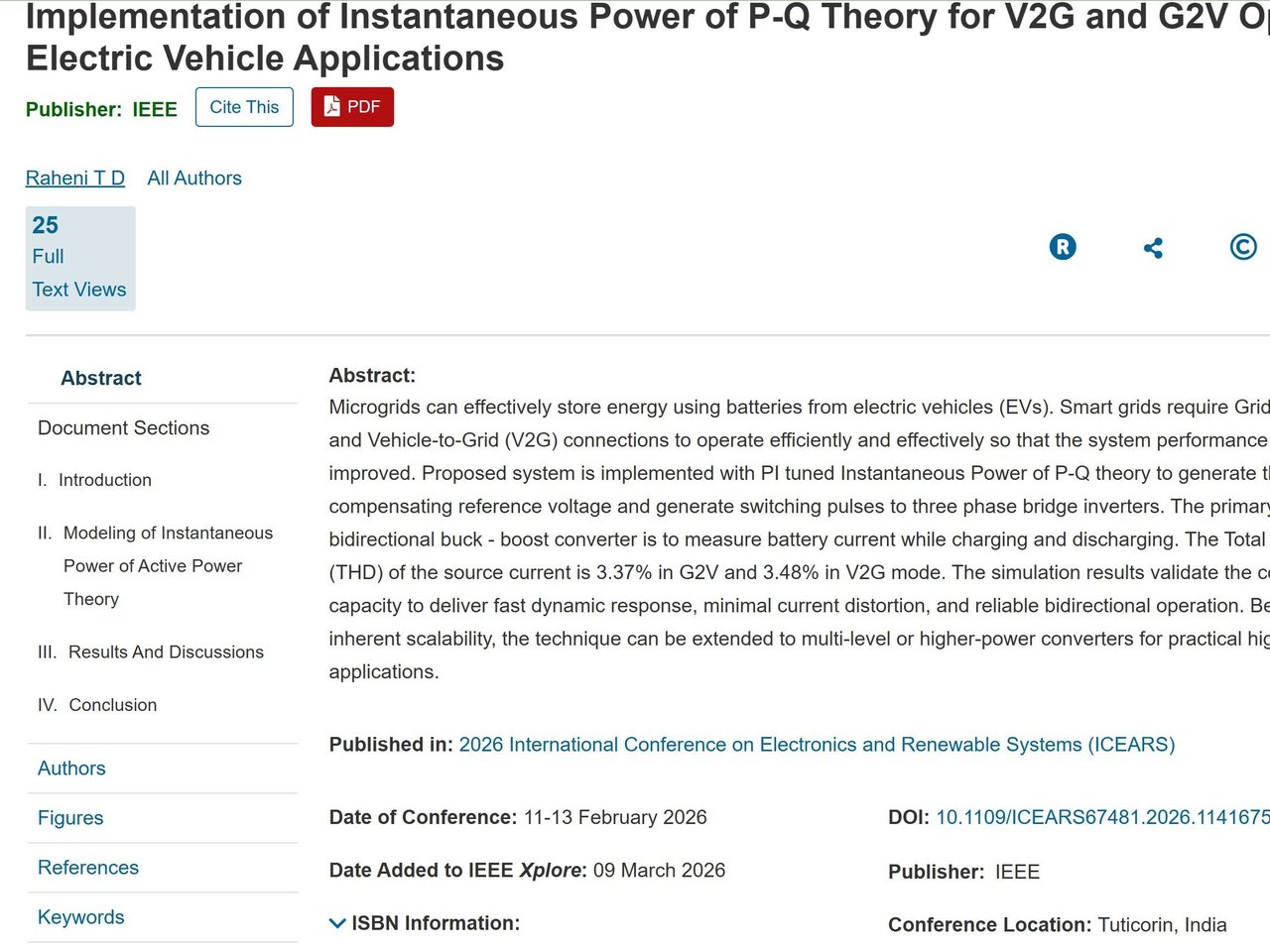
Implementation of instantaneous power of P-Q theory for V2G and G2V operation in electric vehicle applications
Jan 2026 - Feb 2026
India
My research developed a PI-controlled bidirectional EV charging system that enables efficient G2V and V2G power transfer while reducing harmonics, improving power quality, and supporting smart grid applications through intelligent control of power electronic converters.
Research Project
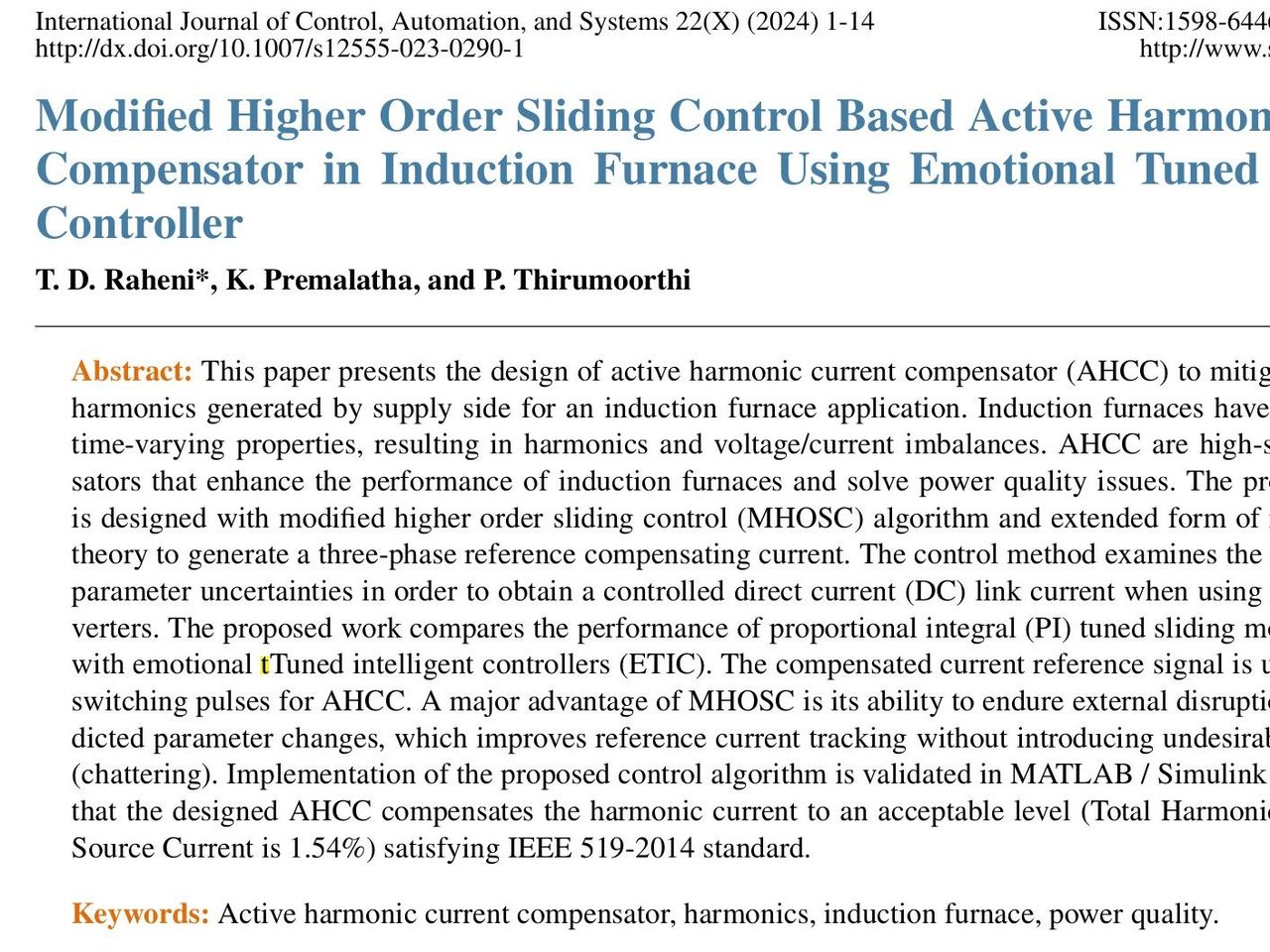
Modified Higher Order Sliding Control Based Active Harmonic Current Compensator in Induction Furnace Using Emotional Tuned Intelligent Controller
May 2023 - Apr 2024
India
The design of active harmonic current compensator (AHCC) to mitigate the current harmonics generated by supply side for an induction furnace application. Induction furnaces have nonlinear and time-varying properties, resulting in harmonics and voltage/current imbalances. AHCC are high-speed compen sators that enhance the performance of induction furnaces and solve power quality issues. The proposed system is designed with modified higher order sliding control (MHOSC) algorithm and extended form of reactive power theory to generate a three-phase reference compensating current. The control method examines the sliding surface parameter uncertainties in order to obtain a controlled direct current (DC) link current when using nonlinear con verters. The proposed work compares the performance of proportional integral (PI) tuned sliding mode controllers with emotional tTuned intelligent controllers (ETIC). The compensated current reference signal is used to provide switching pulses for AHCC. A major advantage of MHOSC is its ability to endure external disruptions and unpre dicted parameter changes, which improves reference current tracking without introducing undesirable oscillations (chattering). Implementation of the proposed control algorithm is validated in MATLAB / Simulink demonstrating that the designed AHCC compensates the harmonic current to an acceptable level (Total Harmonic Distortion of Source Current is 1.54%) satisfying IEEE 519-2014 standard.
Research Project
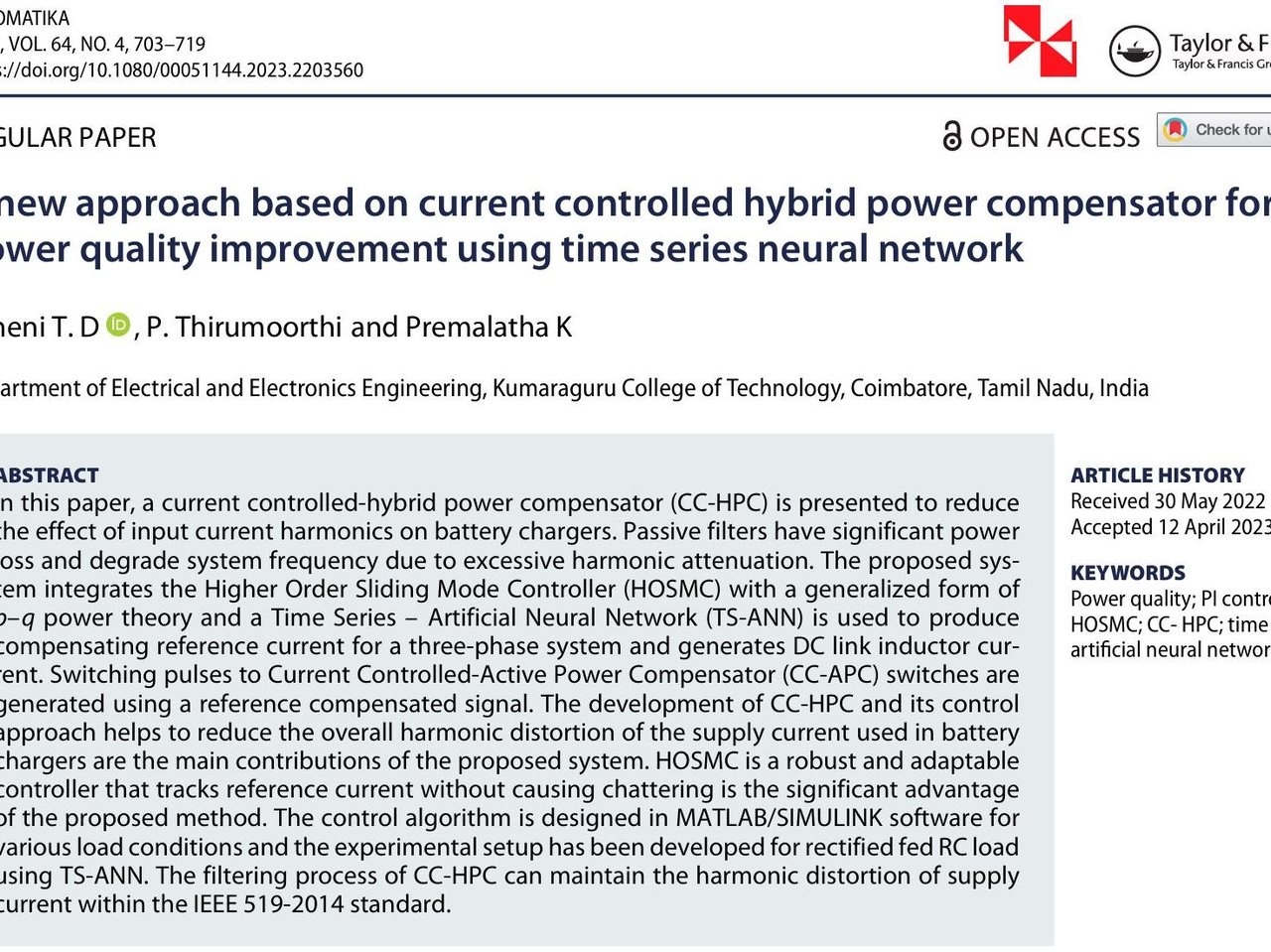
A new approach based on current controlled hybrid power compensator for power quality improvement using time series neural network
May 2022 - Apr 2023
Kumaraguru College of Technology
Developed a Current-Controlled Hybrid Power Compensator (CC-HPC) for battery charger applications.
Combined Higher Order Sliding Mode Control (HOSMC) with generalized p–q theory for harmonic compensation.
Applied Time Series Artificial Neural Network (TS-ANN) to generate accurate compensating reference currents.
Eliminated the chattering effect while achieving robust current tracking.
Reduced supply current harmonics and maintained THD within IEEE 519-2014 limits.
Validated the proposed controller through MATLAB/Simulink simulations and experimental implementation.
Research Projects - Google Scholar Link
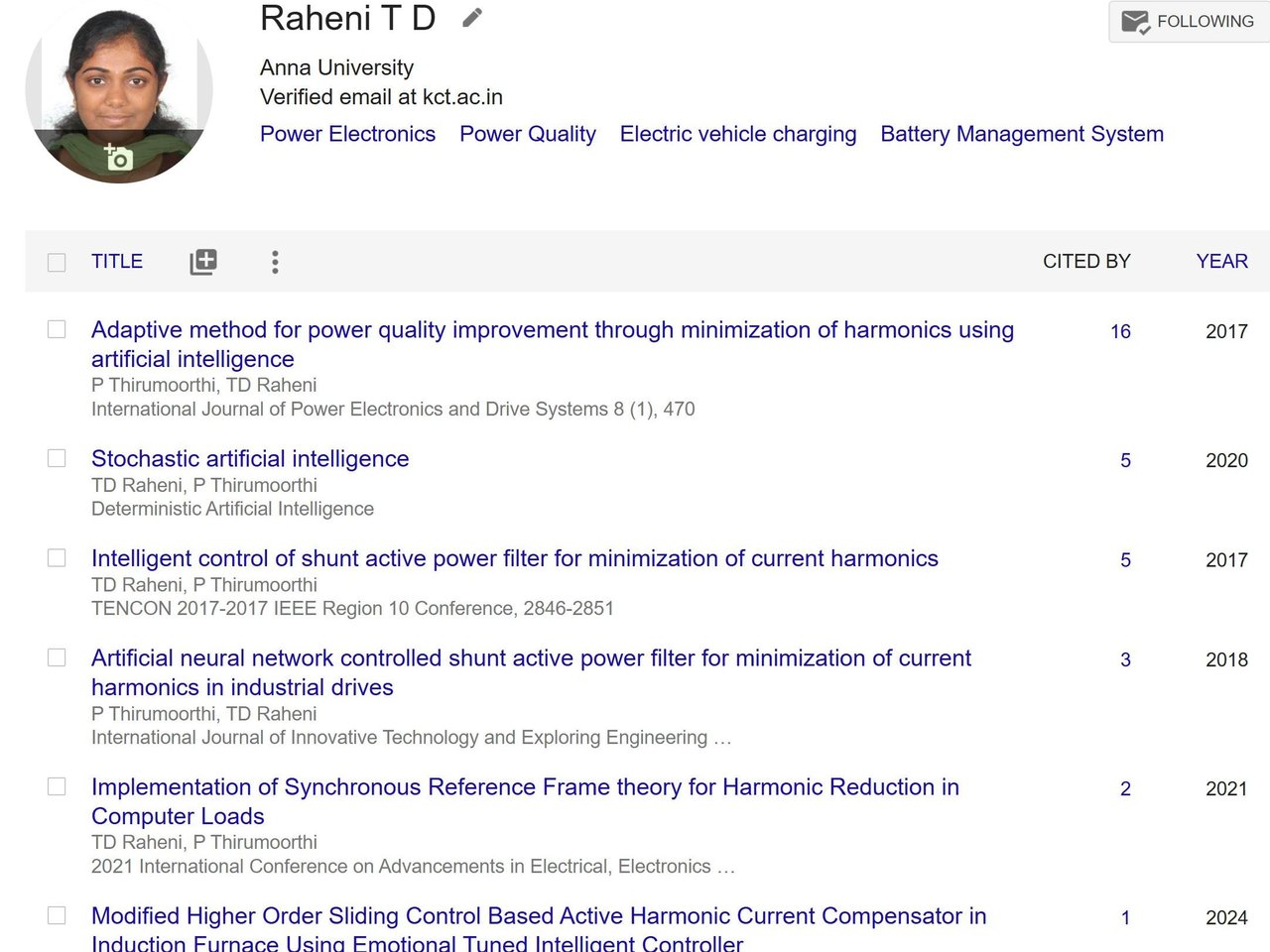
Research Project - Google Scholar Raheni
Jul 2017 - Dec 2023
India
My research focuses on the design, development, and implementation of intelligent control techniques for power electronic systems, with particular emphasis on power quality improvement, harmonic mitigation, electric vehicle (EV) charging systems, battery energy management, and smart grid applications. The primary objective of my research is to enhance the efficiency, stability, and reliability of electrical power systems through advanced control algorithms and intelligent optimization methods.During my doctoral research, I developed active and hybrid power compensation systems to mitigate current harmonics generated by nonlinear loads and battery charging systems. My work integrates Modified Synchronous Reference Frame (MSRF) theory, Instantaneous Power (p–q) theory, and advanced intelligent controllers, including PI controllers, Higher-Order Sliding Mode Control (HOSMC), Super-Twisting Sliding Mode Control (STSMC), Artificial Neural Networks (ANN), Time Series Artificial Neural Networks (TS-ANN), and Brain Emotional Learning-Based Intelligent Controllers (BELBIC), to achieve accurate current tracking, fast dynamic response, and robust system performance.
My research also extends to Grid-to-Vehicle (G2V) and Vehicle-to-Grid (V2G) technologies, where I developed intelligent bidirectional charging strategies for electric vehicles using advanced power converter topologies and control algorithms. These studies focused on improving charging efficiency, reducing harmonic distortion, supporting renewable energy integration, and enhancing smart grid stability while complying with the IEEE 519 power quality standard.
The proposed control strategies were designed, simulated, and validated using MATLAB/Simulink, followed by experimental verification on laboratory prototypes under various operating conditions. My research has demonstrated significant improvements in power quality, Total Harmonic Distortion (THD) reduction, dynamic response, and energy management.